In recent months the UK has experienced record-breaking temperatures, with multiple heatwaves since May 2026 raising growing concerns about the impact of extreme heat on workers, equipment, the environment and industrial productivity.
With no statutory maximum workplace temperature in the UK, an important question arises: at what point does extreme heat make it unsafe for foundries to continue operating?
Across the UK, businesses are adapting their working practices to cope with increasingly frequent periods of extreme heat. In many workplaces, air conditioning can be installed or upgraded to help maintain safe temperatures for staff and protect IT equipment. However, managing heat in industrial environments can be more challenging. In a conventional factory, for example, businesses may need to consider reducing machinery use, improving ventilation or introducing additional cooling measures to maintain safe working conditions.
For foundries however, the challenge is particularly complex. Unlike many workplaces, foundries cannot simply reduce their primary source of heat when outdoor temperatures rise as the high temperatures generated by melting and casting metals are fundamental to the manufacturing process. As external temperatures increase, cooling and ventilation systems must work harder to maintain safe and stable working conditions, potentially increasing electricity consumption while placing additional strain on equipment.
Within investment casting foundries, there is an additional challenge because temperature control can be vital for the casting processes itself. Wax patterns are required to be produced and stored within controlled temperature ranges to maintain their shape, dimensional accuracy and consistency. With the recent extreme heats, this can result in greater reliance on air conditioning and temperature-controlled environments to prevent the softening or deforming of wax patterns, adding further energy demands to the process.
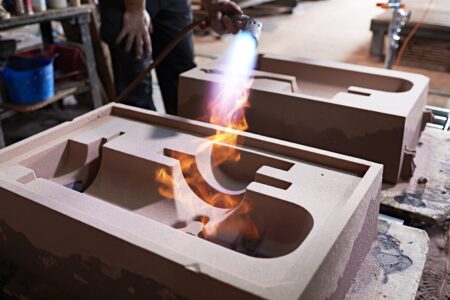
Sand casting foundries presents a different but equally significant challenge. Metals must still be melted at extremely high temperatures, depending on the alloy and casting process. This means the primary source of heat cannot simply be reduced when temperatures outside begin to rise. Instead, cooling and ventilation systems must work harder to maintain safe and stable operating conditions, which can increase electricity consumption and place additional strain on equipment.
This presents a particular challenge within the UK’s existing approach to workplace temperatures. The Health and Safety Executive (HSE) explains that there is no meaningful upper temperature limit that can be applied across all workplaces because in certain industries, high temperatures are generated by the work itself. The HSE specifically identifies foundries as an example, noting that some indoor workplaces have high temperatures that are not seasonal but are created by work activity.
So, how has NovaCast Beaten the Heat?
At NovaCast’s UK Foundry this is something the company has closely monitored during the past few months. With temperatures being recorded within the foundry at 37-42 degrees on the hottest days, it’s been a race against the clock to get work done in comfortable conditions before the temperatures peaked. Adapting healthy working patterns to earlier starts and earlier finishes has been essential in helping keep foundry workers safe during periods of extreme heat. On particularly scorching days, NovaCast has taken the decision to close the foundry for the day where necessary, prioritising the safety and wellbeing of its workforce and preventing equipment being damaged from prolonged heat exposure.
Managing Director Richard Phillips has said, “In all my 48 years in the foundry it has never resonated more about global temperature increases than in 2026. It is not just about our workers here, but globally, NovaCast now sources from different parts of the world, we have been hearing the same problems with heat related issues, with some factories closing for up to a week. Foundry work is relentless in extreme heat, our duty of care to our staff and supply chain is a high priority. At our UK foundry we have ensured that all personnel have everything they need to remain cool, where possible.
The increased heat also emphasizes another problem the world is encountering with water and the solutions needed to ensure water is available to all. At NovaCast we are working hard with a key customer to ensure water is available and sustainable into the future.”
Overseas our foundries within China have experienced similar impaction from the recent heatwaves. Emily NovaCast’s Sourcing and Supply Chain Manager has commented
“July is the main period of high‑temperature weather in China this year. Multiple heatwaves hit Northwest China, North China and the Huang‑Huai region. In some areas, one heat wave can bring temperatures above 35℃ for five to eight days in a row.
Northeast China is unusually hot this year. In July and August, many places in Liaoning and Jilin frequently see temperatures over 35℃. Many weather stations have set new records for the highest temperature in August.
Foundries and machining factories must stop work during periods of high temperature. This has led to minor adjustments to the delivery time of some orders.
However, it has not caused large‑scale production shutdowns or widespread delivery delays. At present, both foundries and machining factories are back to normal production and are making every effort to catch up on the schedules affected by the delays.”
For future heatwaves this prompts the question – how will UK Foundries prepare for future extreme weather conditions?